

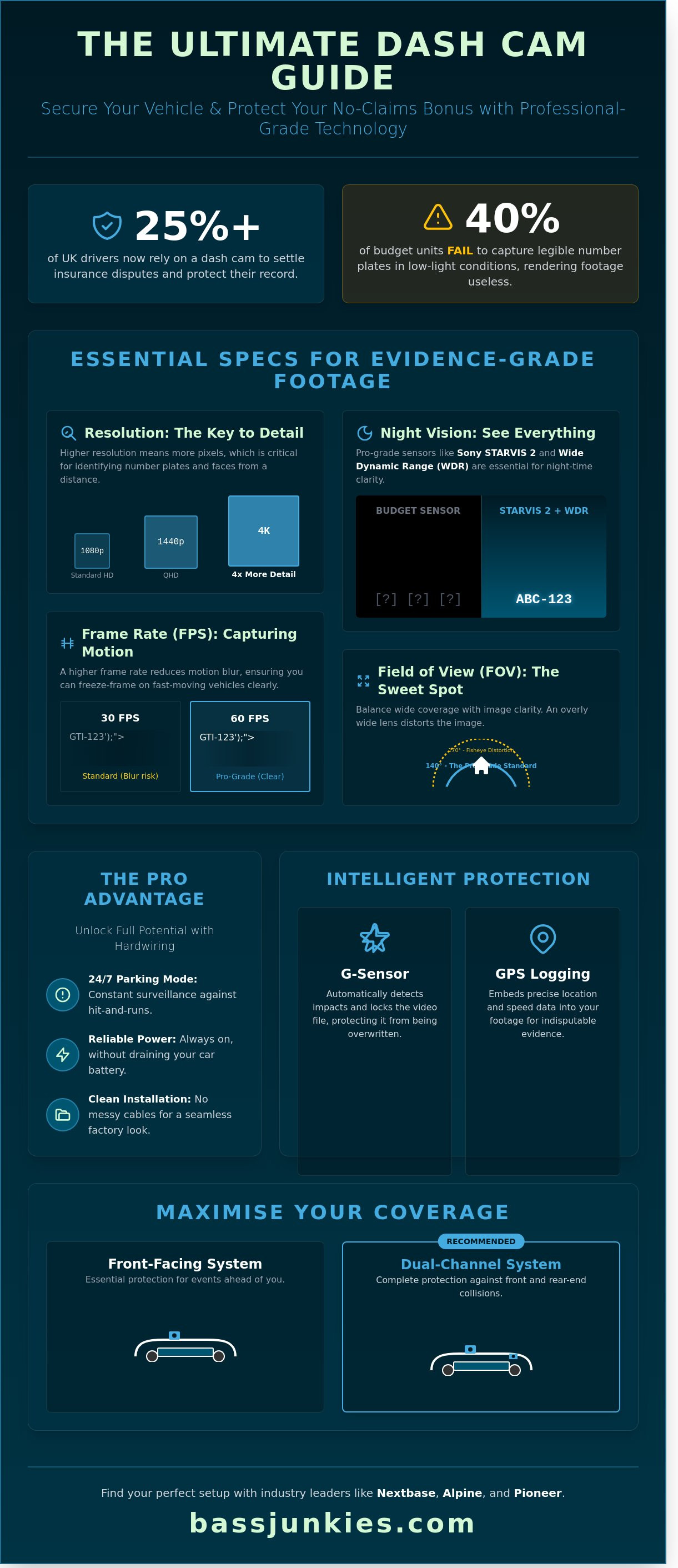
Over 25% of UK drivers now rely on a dashboard camera dash cam to settle insurance disputes, yet 40% of budget units fail to capture legible number plates during night-time driving. A high-performance dashboard camera dash cam provides 4K video evidence, GPS speed logging, and G-sensor incident detection to protect your licence and your no-claims bonus. For 2026, professional-grade protection requires a Starvis 2 sensor for crystal-clear night vision and a dedicated hardwire kit to enable intelligent parking modes without risking battery drain.
You want the absolute security of a digital witness, but you don't want messy power cables cluttering your windscreen or grainy footage that lets you down when it matters most. We promise to give you the definitive breakdown on high-performance hardware and professional installation techniques to keep your vehicle safe. This guide covers the latest 2160p resolution standards, seamless factory-look wiring, and how to choose the ultimate setup for total peace of mind while parked on UK roads.
Key Takeaways
- Secure your vehicle with a dashboard camera dash cam to provide indisputable video evidence for UK insurance claims and police investigations.
- Master technical specs like 4K resolution and 60fps to capture crystal-clear number plates and high-speed action without motion blur.
- Maximise your coverage with dual-channel systems that protect against rear-end collisions and eliminate dangerous blind spots.
- Upgrade to a professional hardwired installation to unlock 24/7 parking surveillance and a permanent, high-performance power source.
- Explore ultimate high-spec units from industry leaders like Nextbase, Alpine, and Pioneer for the best in-car protection.
What is a Dashboard Camera and Why is it Essential?
A dashboard camera dash cam is a compact digital video recorder mounted to a vehicle's windscreen that captures every second of your journey in real-time. This device serves as an automated eyewitness, providing high-definition video evidence that is vital for resolving insurance disputes and supporting police investigations following a road traffic collision. Modern units record onto high-speed microSD cards and feature loop recording to ensure the latest footage is always available. Beyond simple video, these systems integrate GPS logging to track exact coordinates and G-force sensors to measure impact intensity. Installing a professional-grade unit ensures that every incident, from a minor scrape to a major accident, is documented with absolute precision.
Modern technology has transformed these devices from basic recorders into sophisticated data hubs. High-end models now include features like 4K resolution, wide-angle lenses, and night vision sensors to maintain clarity in low-light conditions. According to Wikipedia's overview of dashcams, these devices are increasingly used worldwide for safety and insurance purposes. Many units also record speed data, which can prove you were driving within legal limits during an incident. This technical data removes all guesswork from a claim, protecting drivers from fraudulent "crash for cash" scams that cost UK motorists millions of pounds annually.
The Legal and Insurance Benefits in the UK
UK insurers now widely accept dash cam footage to accelerate "no-fault" settlements, often reducing the claim process from months to weeks. By providing clear visual proof, you protect your No Claims Bonus (NCB) and avoid the financial sting of increased premiums. The UK police also support this technology through "Operation Snap," an initiative allowing drivers to submit footage of dangerous driving directly to local forces for prosecution. In 2023, thousands of motorists used their recordings to help remove reckless drivers from British roads. Having this footage can be the difference between a protected record and a massive spike in your annual insurance costs.
Peace of Mind with Parking Protection
Advanced dash cams act as a 24/7 silent witness through dedicated parking modes. When your car is stationary, a built-in G-sensor detects physical impacts, such as a "hit and run" in a supermarket car park, and triggers an emergency recording. You can choose between motion detection, which records when someone approaches the vehicle, or time-lapse modes for constant overnight surveillance. For taxi and fleet operators, interior-facing "cabin" cameras are essential for driver safety and dispute resolution. You can find these high-spec units in our security and safety collection to keep your vehicle protected even when you are not behind the wheel.
- Indisputable Evidence: High-definition video provides a factual account of road incidents.
- Financial Protection: Safeguard your No Claims Bonus and avoid fraudulent claims.
- Police Integration: Submit footage to Operation Snap to help improve road safety.
- Constant Security: Parking modes protect your vehicle from "hit and run" incidents while unattended.
Essential Technical Specs for a Pro-Grade Dash Cam
A pro-grade dashboard camera dash cam must deliver 4K (2160p) resolution at a minimum of 30fps or 1440p at 60fps to provide evidence-grade footage. High-end Sony STARVIS sensors and Wide Dynamic Range (WDR) are mandatory for capturing clear number plates in low-light conditions. A 140-degree field of view offers the ultimate balance between wide-angle coverage and image clarity. These technical benchmarks ensure your recordings are sharp, usable, and legally robust during an insurance claim.
Resolution is the foundation of any high-performance setup. 4K recording provides four times the pixel density of standard 1080p HD, which is the difference between seeing a blurred shape and reading a specific number plate from 15 metres away. For motorway driving, frame rate becomes the priority. A 60fps setting captures double the frames of a standard camera; this eliminates motion blur on fast-moving vehicles and ensures smooth playback when you need to freeze a frame to identify a driver.
Field of View (FOV) requires a precise balance to maintain technical authority. While a 170-degree lens sounds impressive, it often creates a "fisheye" effect that distorts distances and makes objects look further away than they are. We recommend a 140-degree lens because it captures the entire width of the road and the pavement without compromising the structural integrity of the image. For night-time performance, Sony STARVIS sensors use back-illuminated pixel technology to increase light sensitivity, pulling thumping detail out of the shadows where cheaper sensors fail.
Resolution vs. Storage Requirements
Higher resolution creates massive data files that will crush a standard SD card. A single minute of 4K footage can consume up to 300MB of space, meaning you need high-endurance storage to keep up with the constant overwrite cycles. U3-rated microSD cards are mandatory for 4K recording to ensure the minimum write speed never drops below 30MB/s. If you choose a lower-tier card, the camera will likely crash or drop frames during a critical incident. You can view professional dash cams and security systems that include the high-spec hardware needed for these demands.
Advanced Smart Features
Modern units are packed with connectivity options like built-in Wi-Fi and Bluetooth for instant footage downloads to your smartphone. This eliminates the need to remove the SD card or use a PC to view a clip after an accident. Cloud-enabled cameras take this further by offering real-time alerts and remote live-viewing via a 4G connection. Intelligent Parking Mode is another essential, using G-sensors to "wake up" the camera the moment an impact is detected, ensuring you catch hit-and-run offenders even when the vehicle is unattended.
Front and Rear Dash Cam Systems: Maximising Coverage
A dual-channel dashboard camera dash cam provides 360-degree protection by recording high-definition footage from both the front windscreen and the rear window simultaneously. Front-only cameras leave drivers vulnerable to rear-end shunts and "crash for cash" scams targeting the back of the vehicle. These dual systems use a primary front unit to process video data from a secondary rear sensor via a high-speed coaxial or USB-C cable. Professional installation ensures these cables are hidden behind factory trim panels to maintain vehicle safety and aesthetics.
Technical performance in dual-channel units depends on efficient data transfer and power management. Processing two high-bitrate video streams requires powerful chipsets to prevent overheating and frame drops. These units manage power consumption through dedicated hardwire kits that draw from the 12V battery. These kits include voltage-sensing cut-offs that stop the camera from drawing power if the vehicle battery drops below a specific threshold, typically 12.2V. Linking a dash cam with a reversing camera creates a comprehensive visibility suite that covers every angle of the vehicle.
The Advantages of Dual-Channel Protection
Capturing evidence of tailgating is a massive benefit of rear-facing sensors. Aggressive driving often starts behind the vehicle, and having a secondary lens ensures you record the registration plates of offending drivers before any impact. Modern systems support synchronised playback, allowing you to view both front and rear angles side-by-side on your stereo screen for immediate incident review. For van owners or drivers of hatchbacks with limited rear visibility, these cameras provide a constant, unobstructed view of the road behind.
Installation Considerations for Rear Cameras
Professional fitting involves routing cables through factory rubber grommets to ensure a waterproof and tidy finish. This prevents the common DIY mistake of pinched wires or water leaks into the boot area. Mounting positions are critical; we typically mount sensors on the interior glass, but exterior waterproof housings are available for commercial vehicles. We ensure the lens position does not interfere with heated rear window elements, which can cause visual "banding" or distortion on the recorded footage during winter months.
- Dual-channel setups eliminate blind spots by recording rear-end collisions and tailgating.
- Professional cabling through factory grommets maintains the vehicle’s weather seal.
- Voltage-sensing hardwire kits prevent the dashboard camera dash cam from draining the car battery.
- Synchronised playback provides a complete chronological record of any road incident.
Hardwiring Your Dash Cam: The Professional Advantage
Hardwiring a dashboard camera dash cam provides a permanent power connection that enables 24/7 security and a clean factory finish. Using a cigarette lighter socket is a tactical error; it leaves cables exposed and usually cuts power the moment you park. A professional hardwire installation taps directly into your car's fuse box, allowing the camera to remain active in parking mode to capture hit-and-runs or vandalism. This setup includes built-in voltage protection to ensure your vehicle battery never drops below a safe starting level. It's the ultimate upgrade for any driver serious about evidence and vehicle safety.
Relying on the 12V accessory socket is a temporary fix that compromises your vehicle's security. These sockets are typically "ignition live," meaning the power dies as soon as you turn the key. If someone clips your wing mirror or keys your door while you're in the shops, a camera plugged into the lighter socket won't record a second of it. Hardwiring bridges this gap, turning your camera into a round-the-clock sentry that guards your pride and joy while you sleep.
A professional fit also eliminates the "spider web" of cables often seen in DIY setups. We route the power lines behind the headlining and down the A-pillar, tucking them away from view. This achieves a factory finish that looks like the camera was built into the car at the assembly plant. It also keeps your 12V socket free for charging your phone or running other essential gear.
How Hardwire Kits Work
Hardwire kits function by connecting your camera to the vehicle fuse box using "piggyback" fuse holders. This method is safe and non-destructive because it adds a new circuit without cutting into original factory wiring. A high-quality hardwire kit features a low-voltage cut-off switch. This switch monitors the car battery and automatically shuts off the camera if the voltage drops below a specific threshold, typically 11.6V or 11.8V, to ensure you can always start your engine.
Professional fitters configure the system to distinguish between "Ignition Live" and "Permanent Live" circuits. The ignition feed tells the camera when you're driving, while the permanent feed provides the power needed for motion detection and impact sensing while parked. This intelligent switching ensures the camera only uses high-power recording modes when necessary, preserving your battery life for the next morning's start.
DIY vs. Professional Fitting
Running cables yourself might seem simple, but modern cars hide complex safety systems behind their trim. Improper cable routing often interferes with side-curtain airbags located in the A-pillar. If a cable crosses the path of an airbag, it can prevent deployment or turn the wire into a dangerous projectile during a collision. Professionals route cables behind the airbag modules to maintain full safety compliance.
Expert installation also covers technical calibration. A dashboard camera dash cam relies on a correctly aligned G-sensor to detect impacts and GPS modules to track speed accurately. We ensure every unit is levelled and configured for the specific rake of your windscreen. For a deeper look at hardware options, see our Dash Cam Buying Guide 2026 for more on setup.
Ready to secure your vehicle with a professional installation? Explore our full range of security and safety tech to find the perfect match for your car.
Top Dash Cam Brands and Expert Upgrades at Bassjunkies
Bassjunkies stocks the UK’s leading hardware from Nextbase, Alpine, Pioneer, and Kenwood to ensure every professional dash cam fitting across the UK meets elite standards. We provide expert installation of high-spec dashboard camera dash cam systems that integrate seamlessly with your vehicle's power and data networks. Nextbase offers award-winning iQ technology and Emergency SOS features. Alpine and Pioneer units allow for direct head unit integration. Kenwood delivers superior low-light optics for night driving. Combining these with our security and safety upgrades creates a total protection package for your car or van.
Nextbase Series 2 and iQ Innovations
Nextbase remains the UK's top choice for its reliability and the groundbreaking iQ series. The Emergency SOS feature is a life-saver; it alerts emergency services with your GPS location and medical details if you are unresponsive after an accident. Their Click&Go PRO magnetic mount is the most stable in the industry because it uses high-strength magnets and integrated power connectors to eliminate cable wobble. The Nextbase 622GW is the ultimate choice for 4K stability because it utilises advanced digital image stabilisation to neutralise road vibrations and ensure your high-resolution footage remains perfectly smooth.
Integrating Cameras with Your Audio System
We specialise in building a complete in-car tech ecosystem by linking your camera to your audio setup. For drivers with compatible aftermarket units, you can view dashboard camera dash cam footage directly on your Apple CarPlay screen or Android Auto interface. This setup allows the camera to act as a secondary input for parking assistance, providing a clear rear-view feed when reversing into tight spots. Our expert advice ensures your dash cam, head unit, and security sensors work as one unified system.
Kenwood units are built for the long haul, featuring high-end CMOS sensors that provide excellent low-light performance. Alpine and Pioneer systems are designed for enthusiasts who already have high-spec head units. These brands offer high-bitrate recording and wide dynamic range (WDR) to handle glare and shadows. We don't just stick a camera to the glass; we hardwire it into the fuse box for a factory-finish look.
- Nextbase: UK favourite for ease of use and award-winning "iQ" technology.
- Alpine and Pioneer: High-spec integration for drivers with existing aftermarket head units.
- Kenwood: Known for robust build quality and excellent low-light performance.
- Total Protection: Combine your camera with security upgrades for 360-degree vehicle safety.
Getting the right fitment matters. Our expert team handles the complex wiring required for parking modes and multi-camera setups. We ensure your dash cam doesn't just record the road, but becomes a permanent, reliable part of your vehicle's safety kit. Visit us for expert advice and massive savings on the latest tech.
Secure Your Vehicle with Pro-Grade Surveillance
Investing in a high-performance dashboard camera dash cam isn't just about recording footage; it's about securing undeniable evidence and total peace of mind on UK roads. You need a system that offers 4K resolution and front-to-rear coverage to capture every critical detail during an incident. Hardwiring your unit is the only way to unlock 24/7 parking mode protection and achieve a clean, professional finish without trailing cables cluttering your cabin.
Since 1995, Bassjunkies has been the UK's No. 1 specialist for in-car technology. We carry a massive stock of the latest hardware from industry leaders like Nextbase, Pioneer, and Alpine. Our team consists of real enthusiasts who understand the technical nuances of power management and sensor quality. We're here to provide the expert technical advice required to ensure your installation meets professional standards and delivers maximum performance.
Upgrade your ride with the UK’s best range of dash cams at Bassjunkies
Protect your pride and joy with a setup that never misses a beat and keeps you safe on every journey.
Frequently Asked Questions
Do dash cams record sound inside the car?
Most modern dash cam units feature built-in microphones that record audio inside the cabin by default. You can usually toggle this setting off in the device menu if you prefer privacy. High-quality models capture crystal-clear sound, which provides vital context during insurance claims or legal disputes involving road rage or police interactions.
Will a dash cam drain my car battery if left on overnight?
A dash cam won't drain your battery overnight if it's installed using a hardwire kit with an integrated voltage cutoff. These kits automatically shut down the camera if the car battery drops below a specific level, usually 11.6V or 12V. Without a hardwire kit, a camera plugged into a live 12V socket could potentially drain a standard 60Ah battery within 48 hours.
Is it legal to have a dash cam in the UK?
It's completely legal to use a dashboard camera on UK roads. You must ensure the device doesn't obstruct more than 40mm of the swept area of the windscreen or sit directly in the driver's line of sight. Failure to position the camera correctly can result in a £100 fine and 3 penalty points under the Road Vehicles (Construction and Use) Regulations 1986.
How much footage can a 64GB SD card hold on a 4K camera?
A 64GB SD card typically holds between 60 and 90 minutes of 4K footage before it begins overwriting old files. High-resolution 4K video consumes data at a rate of approximately 700MB per minute due to the massive detail captured. For heavy drivers, we recommend upgrading to a 128GB or 256GB U3-rated card to ensure more footage is preserved before the loop cycle restarts.
Do I need a professional to install my dash cam?
Professional installation is essential if you want a clean, hidden finish and reliable 24/7 parking mode. While basic plug-and-play setups work, experts ensure the dashboard camera is hardwired safely into the fuse box without interfering with side-curtain airbags. We use professional tools to route cables behind trim panels, preventing loose wires from hanging across your dashboard.
Can I use a dash cam as a reversing camera?
You can only use a dash cam as a reversing camera if you install a dual-channel system with a dedicated rear-facing unit and a built-in display. Standard front-facing cameras don't provide the wide-angle rear view needed for parking. Specialist models switch the screen to a rear-view feed when you engage reverse gear, providing crystal-clear guidance to avoid obstacles.
What happens to the footage when the SD card is full?
When the SD card reaches its capacity, the camera uses loop recording to overwrite the oldest unprotected files with new footage. This ensures the device never stops recording during a journey. Any footage triggered by the G-sensor during an impact is automatically locked in a separate folder, preventing it from being deleted during the loop process.
Do insurance companies give discounts for having a dash cam?
Several UK insurance providers offer premium discounts ranging from 10% to 15% for drivers who use a dash cam. Companies like Adrian Flux and AXA have previously offered specific policies because the footage provides undeniable evidence in non-fault accidents. You must ensure the camera is active and recording at all times to remain compliant with these policy terms.